There is a growing mismatch in the modern job market that nobody has quite figured out how to name. On one side, you have millions of workers who are genuinely skilled—people who have taught themselves Python, built websites, managed projects, or learned data analysis through online courses, YouTube tutorials, and sheer persistence. On the other side, you have employers who cannot verify any of it. A portfolio can be fabricated. A self-reported skill on a CV can be exaggerated. And in a world where AI can generate a convincing portfolio in minutes, the old proof mechanisms are losing credibility fast.
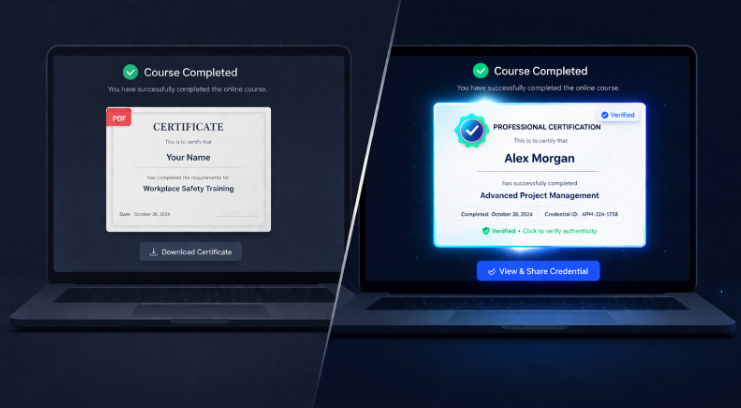
Professional certifications solve that problem. They are verified, standardised, and issued only after a candidate passes a proctored exam. They do not prove you watched a tutorial. They prove you can do the work.
Why Employers Trust Credentials Over Claims
The Bureau of Labor Statistics reports that workers holding professional certifications or licences earn roughly 16 per cent more than uncertified peers in the same occupation. That premium exists because the credential reduces employer risk. Hiring someone with a verified certification is not a gamble on their self-assessment. It is a bet on a standardised, third-party-validated measurement of competence.
This matters more in 2026 than it ever has, for two reasons. First, AI has made it trivially easy to fake competence. Anyone can use a language model to write impressive-sounding cover letters, generate code samples, or create portfolio pieces that look professional. Employers know this, and they are responding by placing more weight on credentials that cannot be faked—exams you either passed or did not. Second, the job market is moving faster than traditional reference-checking can keep up with. When a recruiter reviews 200 applications for a single role, a certification is a binary signal that cuts through the noise instantly.
The Shift Is Already Happening
CVwizard’s 2025 career shift research found that 66 per cent of Gen Z and 65 per cent of Millennials are planning to change jobs this year. Nearly half—47 per cent—identified re-skilling as their biggest barrier. These are not people lacking ambition. They are people who know they need a new credential to make their next move, and the market is responding by building faster, cheaper, more accessible certification pathways in almost every professional field.
The exams behind these credentials are designed to test applied knowledge, not rote memorisation. Scenario-based questions, clinical simulations, and timed problem-solving exercises are standard across healthcare, IT, safety, and education certifications. Candidates who prepare with structured resources like exam prep platforms pass at higher rates because they have practised under conditions that mirror the real test—something passive learning can never replicate.
Credentials as Digital Identity
In the emerging world of digital professional identity, certifications function as verified badges that travel with you across platforms, employers, and borders. A certified cloud professional is recognised in London, Lagos, and Los Angeles. A licensed health worker carries a credential that means the same thing in any hospital. This portability is transformative for a generation that changes jobs every one to two years and frequently works remotely across jurisdictions.
The old career model—one employer, one trajectory, one set of skills for life—is gone. The new model requires a portable, verifiable proof of competence that updates as your career evolves. Professional certifications are the closest thing the labour market has to a universal, trusted standard. And the workers who accumulate the right ones are the workers who move fastest, earn most, and worry least about what happens when the next disruption arrives.
Proof Over Promise
The job market has never been more skeptical of unverified claims or more generous to people who can back theirs up. A professional certification is not a magic credential. It is a signal—a standardised, verified, employer-recognised signal that you can do a specific thing competently. In a world drowning in noise, that signal is worth more than a portfolio full of promises.